
By Evan Brooks
Verdict
Verdict: I prefer TaoMate H3 for subject presentation and composition in the tested presenter and object-handling clips; the existing quantized MiniMax H3 integration is the stronger choice for speed and lower resource use. TaoMate runs with the documented single-device adaptation. This visual preference is based on these samples, not a general quality ranking. Both generated complete audio-video files for three structured English scenarios and an unstructured dialogue diagnostic. Across the three structured scenarios, H3's median full-request time was 84.31 seconds, compared with 419.63 seconds for adapted TaoMate—about one fifth of the wait. Its sampled peak VRAM was 24.77–24.78 GiB, versus 46.45–46.65 GiB for TaoMate.
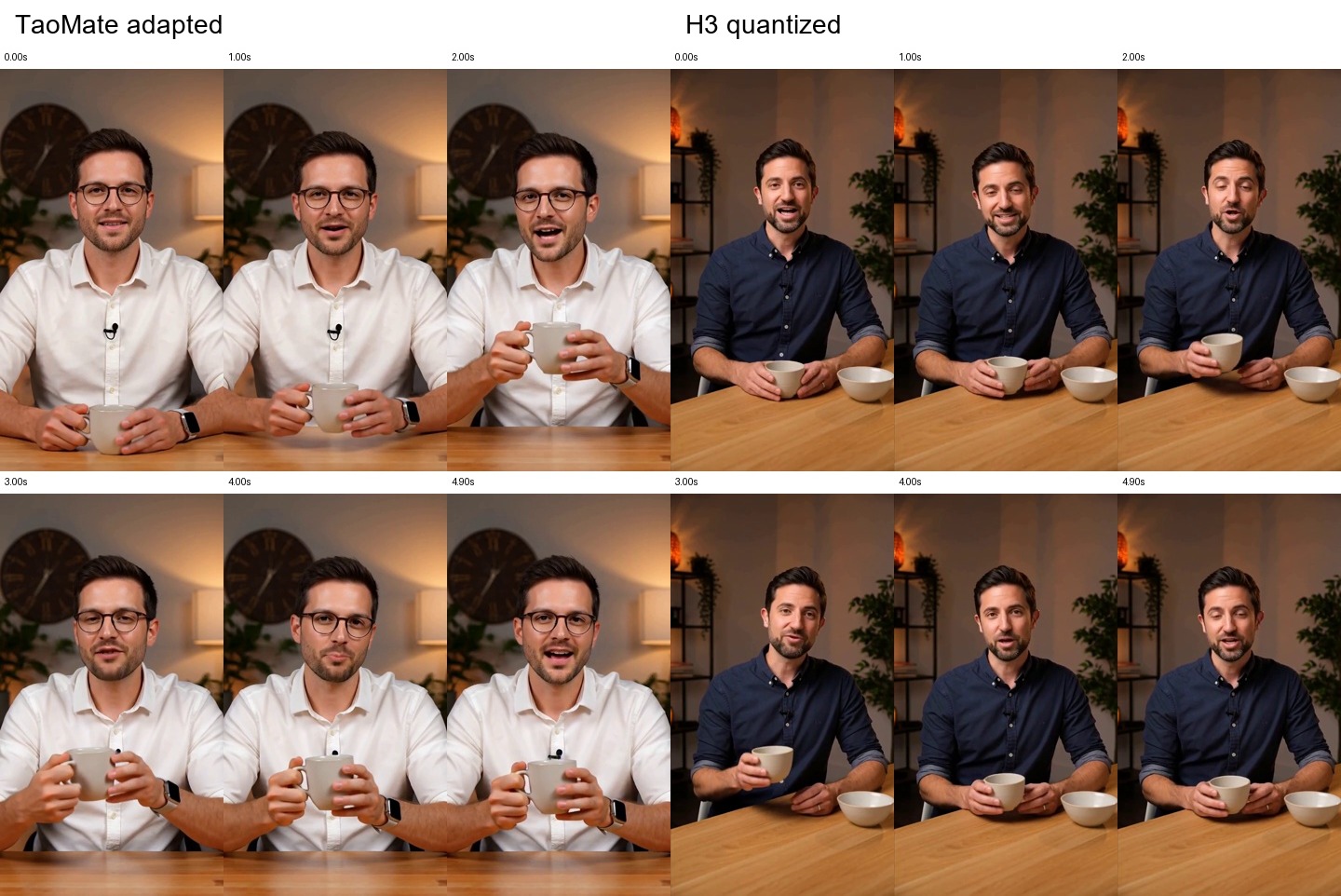
- For subject presentation and composition: I would favor TaoMate in these examples when a longer wait is acceptable. It keeps the speaker's face in the object-handling scene and presents the cup without H3's unrequested extra bowl.
- For faster iteration and lower memory use: I would choose the tested H3 quantized integration.
- For streaming-development experiments: the adapted TaoMate path produces usable inspection files, but its offload overhead makes it slow in this configuration. These runs do not demonstrate real-time generation or validate unmodified upstream execution on one device.
- For quality boundaries: this preference does not extend to every aspect of the output. Both reproduce the structured prompts' requested English lines in automatic transcription; the unstructured prompt produces transcript deviations in both implementations; TaoMate repeats an object movement, while H3 crops the speaker's face out of that scene. Human listening and precise lip-sync assessment remain unverified.
The adaptation was necessary because the released runtime expects four or eight devices and a specialized attention backend, while this test uses one device with roughly a 48 GiB memory budget. The generator alone accounts for about 61.73 GiB of unquantized weight storage, before temporary tensors and decoding. I changed execution and memory placement to make a complete request possible; I did not train a smaller model or make the original optimized path run unchanged.
These conclusions compare two local deployments with different precision, attention backends, and memory policies; they are not an isolated model-algorithm benchmark or a measurement of hosted H3 Max. I tested a studio presenter, object placement, and a moving forest-stream shot using matched English prompts and seeds. The sections below show the outputs, explain the adaptation, and separate demonstrated results from capabilities still awaiting tests.
What TaoMate H3 adds to MiniMax H3
The TaoMate H3 streaming audio-video runtime builds on MiniMax H3 as its foundation. Its contribution is a streaming runtime and an inference adapter that advance small audio-video chunks through a short denoising schedule. The project also maintains clean history between chunks. That combination targets earlier results and continuing generation instead of treating every new piece of video as an independent, full-length request. Its documented resolutions and distributed setup help explain why the compatibility changes below were necessary.
The MiniMax H3 base model belongs to the broader H3 family. Its downloadable base includes a text/keyframe route and a separate reference route; the hosted product also contains processing stages that are not represented by a simple local base-model run. The documentation distinguishes downloadable weights from the hosted pipeline, so I use that narrower local scope when interpreting these results. In this review I exercise text-to-audio-video generation through FL2VA. I do not test reference-image fidelity, voice cloning, video editing, or the hosted high-resolution pipeline.
This distinction has a direct effect on a buying or development decision. A creator may care primarily about getting one usable clip. An application developer may care more about how soon the first portion becomes available and whether the next portion keeps the same character. Those are different goals. My finished-file tests address the first goal and part of the integration work behind the second. They do not demonstrate a live interactive service or prove long-form identity preservation.
Readers weighing hosted tools alongside downloadable weights can use the H3 Max vs MiniMax H3 comparison to keep the product names and feature scopes separate. That distinction matters here: the tests below measure two local deployments and contain no hosted H3 Max latency result.
What I tested, and how to read the comparison
The primary comparison uses three paired structured English scenarios: a presenter introducing a ceramic cup, a woman placing a red cube into a white bowl, and a camera moving along a forest stream. Each pair uses identical prompt text, seed, portrait dimensions, and a nominal five-second duration. The seeds change between scenarios, not between the two implementations within a pair. No input photographs, reference audio, or prompt-enhancement service are involved.
A fourth pair uses the same unstructured studio prompt and seed in both implementations to inspect dialogue control. Its per-run metrics are shown alongside the outputs, separately from the three-scenario summary statistics.
The presenter prompt adapts the first scene of TaoMate's published example into English. It preserves the structured description, dialogue marker, soundscape field, and music field. It is an adapted example, not a claim that I reproduced an unchanged official English demo. The other two scenes deliberately stress different controls. Object placement asks for an observable end state. The stream asks for camera movement and non-speech sound, which can reveal weaknesses hidden by a static talking-head example.
For adapting these shot ideas to a hosted workflow, the H3 Max prompt guide provides a subject, action, camera, visual-treatment, and audio checklist. The TaoMate field names and dialogue markers reproduced below remain specific to the tested request format; the shared planning categories do not make the two interfaces interchangeable.
The two implementations are intentionally identified throughout. TaoMate adapted uses its base weights and adapter with BF16 computation, selected FP32 boundary parameters, PyTorch SDPA attention, and sequential CPU offload. H3 quantized uses the existing ComfyUI conversion, its quantized generator and text encoder, SageAttention, and a 20-step Euler/simple configuration with CFG set to one and no acceleration adapter. This is a comparison of usable deployments, not an isolated test of the TaoMate training method against an otherwise identical H3 sampler.
I ran requests sequentially. TaoMate starts its generation processes for each request; the H3 service is restarted between the new review cases so that each starts with an empty model cache. The timing includes weight loading, text encoding, generation, decoding, and saving the native video. TaoMate's internal audio preparation is included. H3 service startup, downloads, installation, subsequent inspection, and the delivery trim are excluded. These choices make the waiting-time comparison useful while leaving a small process-startup asymmetry that should remain visible.
There is also a frame-count detail worth understanding before comparing files. The model's native geometry uses 124 frames for these requests, or about 5.167 seconds at 24 frames per second. TaoMate publishes a five-second file. I retain H3's native file and make a five-second delivery copy for equal-length viewing. Reported generation time ends at the native save; it does not charge H3 for the later trim. Matching a seed across different runtimes does not guarantee matching faces, composition, or random-number sequences.
Generated works: English inputs and real outputs
Each paired row uses the same complete English prompt and seed in both implementations. Shared settings are T2AV, 480 × 864, a 5-second target, and 24 FPS; every delivery copy contains 120 frames and 5.00 seconds of video. The prompt column preserves the actual input, including dialogue markers and soundscape fields. All four rows contain paired results. The first three structured scenes form the primary timing summary; the fourth is a separate unstructured-prompt diagnostic with its own direct comparison.
| Scenario / seed | Complete English prompt shared by the pair | TaoMate adapted | MiniMax H3 quantized |
|---|---|---|---|
| Studio presenter Seed: 8301 |
integrated_multimodal_description: [Shot 1] Vertical fixed-camera medium shot. An adult presenter sits at a wooden table in a softly lit studio and holds a plain ceramic cup. Identity, clothing, composition, lighting, background, and object placement remain unchanged. No captions, subtitles, overlays, watermarks, logos, or readable text. The presenter looks into the camera and begins naturally. <d>[English] Hello everyone. Today I want to share this everyday ceramic cup with you.</d>overall_soundscape: Clear dry English speech in a quiet room.non_diegetic_music: N/A |
Full request: 382.52 s Peak VRAM: 46.45 GiB Peak RSS: 112.62 GiB Mean / peak GPU use: 30.86% / 100% |
Full request: 84.31 s Peak VRAM: 24.78 GiB Peak RSS: 35.67 GiB Mean / peak GPU use: 71.31% / 100% |
| Object placement Seed: 8302 |
integrated_multimodal_description: [Shot 1] Vertical fixed-camera medium shot. A woman in a plain blue shirt sits at a light wooden table. A single red wooden cube and an empty white ceramic bowl are on the table. She picks up the cube with her right hand and places it inside the bowl. She says: <d>[English] The red cube goes into the white bowl.</d> Her face and clothing stay consistent. Soft daylight, realistic motion. No captions, subtitles, overlays, watermarks, logos, or readable text.overall_soundscape: Clear English speech, a gentle wooden tap as the cube touches the bowl, otherwise quiet.non_diegetic_music: N/A |
Full request: 422.49 s Peak VRAM: 46.65 GiB Peak RSS: 107.41 GiB Mean / peak GPU use: 28.25% / 100% |
Full request: 86.23 s Peak VRAM: 24.77 GiB Peak RSS: 33.52 GiB Mean / peak GPU use: 74.63% / 100% |
| Forest stream Seed: 8303 |
integrated_multimodal_description: [Shot 1] Vertical cinematic shot of a narrow stream flowing over smooth moss-covered stones in a green forest. The camera slowly moves forward along the stream throughout the shot. Sunlight filters through leaves; water visibly ripples and splashes around the stones. Realistic natural colors, stable geography, no people. No captions, subtitles, overlays, watermarks, logos, or readable text.overall_soundscape: Continuous gentle running water and occasional distant bird calls. No speech, narration, singing, or human voices.non_diegetic_music: N/A |
Full request: 419.63 s Peak VRAM: 46.45 GiB Peak RSS: 107.52 GiB Mean / peak GPU use: 28.12% / 100% |
Full request: 84.12 s Peak VRAM: 24.77 GiB Peak RSS: 33.55 GiB Mean / peak GPU use: 77.05% / 100% |
| Unstructured diagnostic pair Seed: 8301 |
A woman in a blue shirt faces the camera and says, "Hello, welcome to our studio." Natural facial movement, clear speech, steady camera, bright indoor lighting. |
Full request: 413.44 s Peak VRAM: 46.18 GiB Peak RSS: 107.57 GiB Mean / peak GPU use: 28.42% / 100% |
Full request: 84.23 s Peak VRAM: 24.77 GiB Peak RSS: 33.51 GiB Mean / peak GPU use: 71.48% / 100% |
All previews are generated artifacts. Resource peaks come from two-second sampling and may miss brief spikes. RSS is the sum across the generation process tree, not a measurement of uniquely owned physical memory. GPU utilization is reported as an average and a sampled peak in the evidence records; it is not a measure of visual quality. Each result has its input, media metadata, execution record, and inspection notes alongside the article assets. The companion package preserves per-run metrics and visual inspection notes for checking these observations.
Presenter: both preserve the requested English line
The prompt asks an adult presenter to hold a plain cup in a fixed studio composition and say: “Hello everyone. Today I want to share this everyday ceramic cup with you.” Both transcripts match that sentence. The samples show a coherent presenter, a cup, and a stable studio setting, with no unwanted captions or readable non-English text in the six inspected frames per clip. TaoMate produces a white-shirted man with glasses; H3 produces a bearded man in a darker shirt. Neither identity was specified, so the difference is not itself a failure.
There are smaller composition differences. H3 adds a white bowl on the table, which the prompt did not request. TaoMate keeps the cup introduction visually straightforward. Both presenters change their mouth and hand positions between sampled frames, but those observations are insufficient to score exact lip synchronization. An exact transcript supports dialogue-content adherence; it does not establish natural intonation or precise audio-to-mouth alignment. For a short product introduction, both examples provide a plausible starting point, with human review still needed before delivery.
Object handling: different defects matter more than a single quality rank
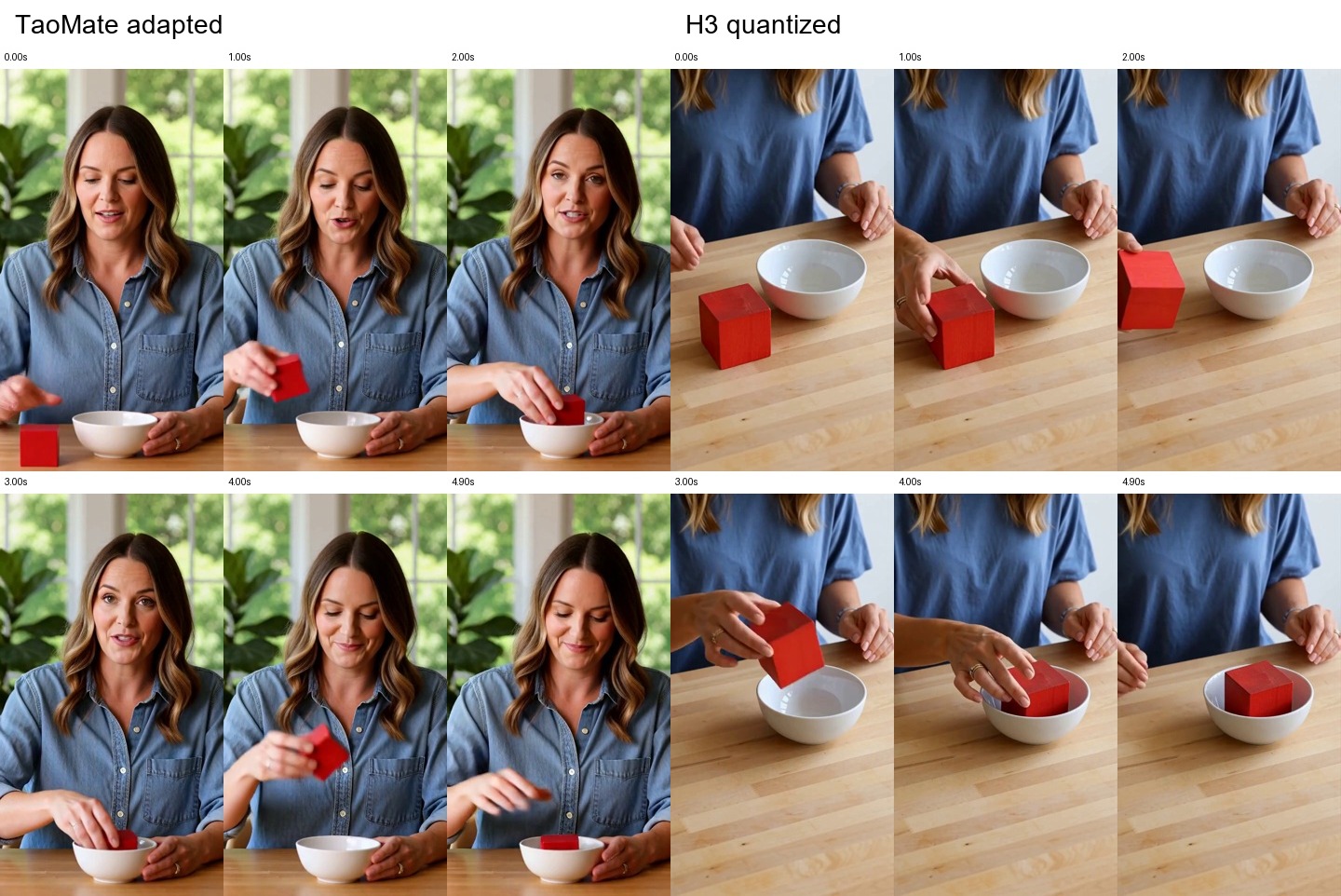
The action prompt requests a woman in blue to use her right hand to put a red cube into a white bowl, accompanied by: “The red cube goes into the white bowl.” Both transcriptions match. In TaoMate's clip, the face stays in view and the cube reaches the bowl around the middle of the sequence. The woman then lifts it again before returning it by the end. The requested final state is achieved, but the extra repetition makes the action less exact than the instruction.
H3 gives a more economical visible placement: the cube enters the bowl and remains there in the final sampled frame. Its framing is much tighter, however, showing the torso and hands while cropping out the face. That makes the action easy to inspect but prevents evaluation of the speaker's facial consistency and lip movement. If the intended deliverable is a close-up demonstration, that crop may be acceptable. If it is a speaking presenter demonstrating an object, the missing face is a meaningful limitation. This pair does not justify saying that one implementation simply has better quality in every respect.
Forest stream: coherent visuals, limited audio evidence
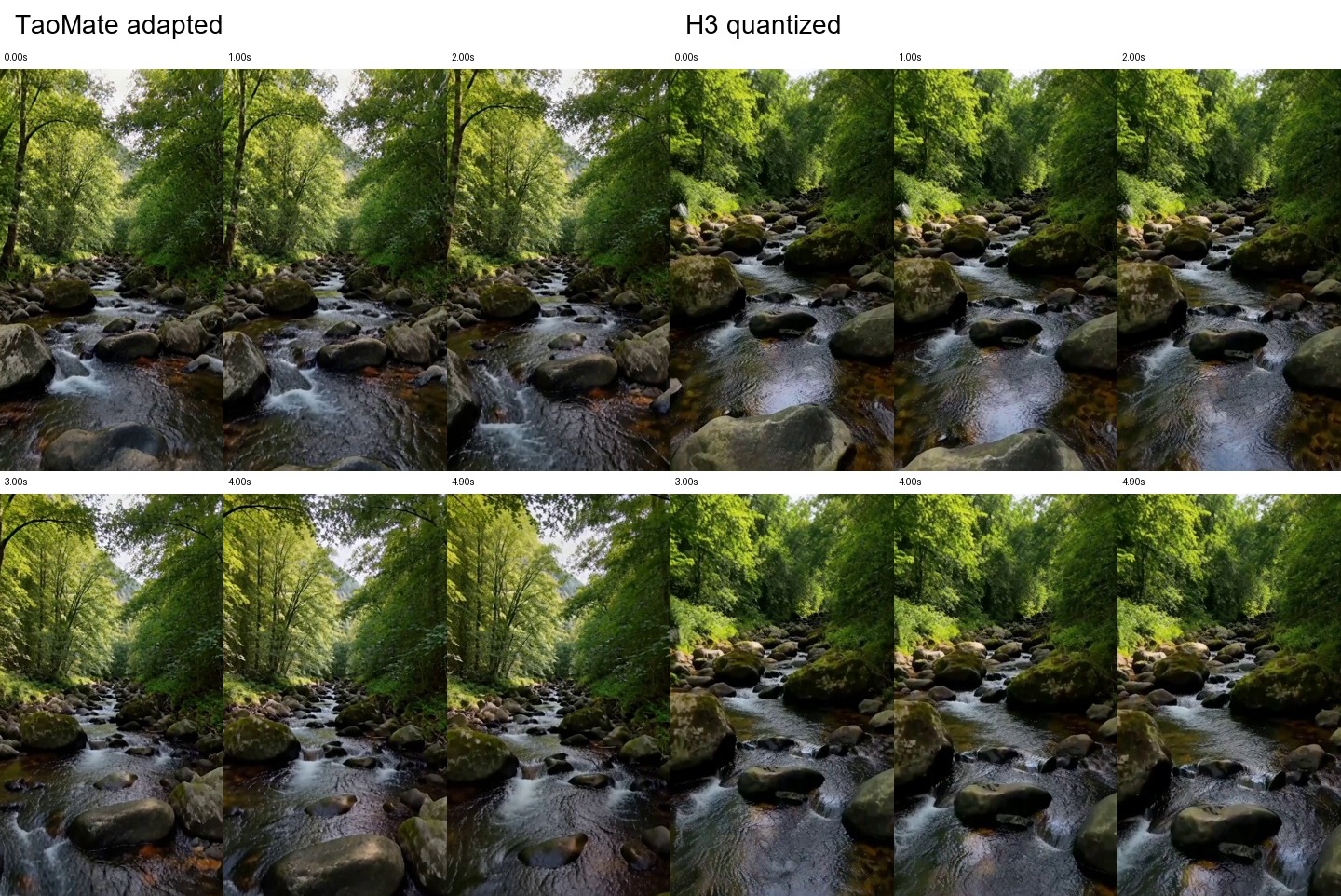
Both nature outputs show a recognizable forest stream, moss-covered rocks, moving water, and a changing viewpoint along the channel. The sampled sequence in each stays within the requested setting without introducing people, captions, or visible text. These are useful checks of broad scene adherence, although six time samples cannot establish the absence of every short-lived distortion. I have not measured camera trajectory or judged either sequence as a physically exact reconstruction of flowing water.
The audio findings are narrower. Both tracks contain a measurable nonzero signal. H3's automatic transcription is empty, while TaoMate's recognizer produces a spurious fragment on the environmental-sound case. That fragment is not credible evidence of intended dialogue or proof that the generation contains narration. I therefore leave the authenticity of water and bird sounds, and strict adherence to the no-voice instruction, unscored pending listening review. A successful audio decode is necessary for an audio-video product, but it is not an ambient-sound quality rating.
Unstructured dialogue: both finish, neither transcript strictly matches
The unstructured prompt asks a blue-shirted woman to say exactly “Hello, welcome to our studio.” Both implementations produce a valid five-second audio-video file. TaoMate takes 413.44 seconds with 46.18 GiB peak VRAM; H3 takes 84.23 seconds with 24.77 GiB peak VRAM, about 4.91 times shorter in this pair. These are individual cold requests, not repeated-run averages.
TaoMate's automatic transcript is “Hello, welcome S3 Aclead at Acquire Twitter Studio.” H3's is “Hello, as in one is having for our studio. Hello, welcome to our studio.” H3 includes the requested sentence, but also an extra leading phrase; neither transcript strictly matches the requested dialogue. This is an automatic-transcription finding, not a human-verified account of every spoken word. Successful decoding does not establish correct speech content.
H3's six sampled frames show a blue-shirted woman facing the camera, with a consistent indoor background and visible mouth and head movement. No captions or readable text are visible in those frames. The TaoMate sample also maintains a coherent blue-shirted woman. Neither sample has a completed human listening or precise lip-sync assessment. The paired videos expose the distinction between a coherent picture and strict dialogue control.
The later structured prompts preserve the project's description, dialogue, soundscape, and music fields. Their speech transcriptions are better in these examples, but the scene and requested sentence also changed. This is consistent with the value of respecting the request format; it is not a controlled experiment proving that formatting alone caused the improvement. I would repeat the same scene and sentence with both formats before making that stronger causal claim.
What the timing does—and does not—tell me
Across the three structured matched scenarios, TaoMate's full requests take 382.52–422.49 seconds, with a median of 419.63 seconds. H3 takes 84.12–86.23 seconds, with a median of 84.31 seconds. The ratio of those medians is 4.98; H3 is the faster finished-file route in this deployment. This ratio is a descriptive comparison of six runs, not a statistically established speedup or a result for an unmodified, matched-precision baseline.
Dividing request time by the five-second delivery duration gives 76.50–84.50 seconds of waiting per output second for TaoMate and 16.82–17.25 for H3. Neither is real-time under this cold-request policy. TaoMate's sampled peak device memory is 46.45–46.65 GiB, compared with 24.77–24.78 GiB for H3. Process-tree peak RSS is 107.41–112.62 GiB versus 33.52–35.67 GiB. These measurements show why system memory is a central part of the compatibility adaptation rather than a minor installation detail.
Average sampled GPU utilization is 28.12–30.86% for TaoMate and 71.31–77.05% for H3; both reach a sampled 100% peak in every paired case. The lower TaoMate average is consistent with substantial loading and transfer overhead, but utilization alone does not quantify the time spent on each cause. I did not profile a complete transfer-versus-compute breakdown. Quantization, attention backend, software versions, and memory policy all differ, so this comparison cannot isolate any one factor.
All six primary-comparison delivery files pass full decode and contain 120 frames at 24 FPS, 480 × 864 pixels, and 5.00 seconds of video. The audio is 32 kHz stereo AAC, with decoded durations of 4.96 seconds for TaoMate and 5.024 seconds for H3. AAC has no fixed PCM bit depth; analysis uses a PCM16 WAV conversion. All tracks contain a nonzero signal with no detected full-scale clipped samples in that conversion. Four of four structured-prompt speech transcripts match their requested lines, while the environmental-sound cases remain outside that speech score.
The most useful speed number for an occasional user is the time between submitting a request and receiving a file they can inspect. That is the number I emphasize here. A researcher optimizing the denoiser may instead want the time spent inside the transformer. A streaming application needs yet another measurement: time until a correctly decoded, playable first segment reaches the client. Those measurements answer different questions, so I would not replace one with another just because it produces a larger improvement figure.
TaoMate's published multi-device benchmark reports a substantial reduction in transformer time and earlier first-chunk availability relative to its H3 baseline. The table explicitly excludes internal audio preparation, and transformer-only timing also excludes loading and decoding. Those qualifications are part of the result, not fine print. My single-device adaptation changes attention, placement, precision policy, and execution overhead. Its full-request times cannot validate or refute that official matched benchmark. Those benchmark definitions need to stay attached to any capacity estimate based on the official figures.
For a production queue, I would add repeated warm runs, varied durations, and accepted-output counts before calculating throughput. A fast clip that fails its instructions may cost another complete generation. A slower clip that is accepted immediately may be cheaper in practice. This small review keeps the raw waiting times and visible failures together so that readers can make that distinction. It does not invent a success-adjusted cost from three scenarios or assume that the next request will behave identically.
Why I adapted the runtime
The immediate goal was to generate a complete clip on the available single-device machine. The released TaoMate configuration supports four or eight collaborating devices, and its optimized attention path targets a different accelerator architecture. The available machine therefore differs from the official execution plan in both device count and kernel compatibility. Setting the device count to one cannot supply the missing communication partners or make an architecture-specific kernel compatible. This is why the work required code changes rather than only installation or a smaller resolution setting.
Memory was a second, independent obstacle. The generator is only one part of the working set. Text encoding, adapter weights, intermediate activations, historical attention state, and video decoding also need space at different moments. In the examined source, the generator parameters alone correspond to roughly 61.73 GiB of unquantized weight storage. That figure is not a total GPU requirement, because the parameters need not all reside there at once, but it explains why naive whole-model placement was unsuitable for a single-device compatibility path.
My goal was therefore concrete: retain the released TaoMate adapter and its generation behavior closely enough to produce inspectable audio-video outputs, while changing where computation happens and how much stays resident. I did not retrain the model, create a new distilled checkpoint, or claim to reproduce the original optimized throughput. I also avoided making a successful launch the finish line. The useful result had to include a decodable video, a nonempty audio signal, and evidence that the requested scene was actually present.
That choice creates a familiar tradeoff. Moving weights from system memory allows a larger model to run within a smaller device budget, but data transfer and repeated placement become part of inference. It is comparable to bringing only the tools needed for the next operation onto a crowded workbench. The job fits; the trips to storage still take time. Offload is therefore an enabling technique in this review, not a performance claim or proof that every longer request will fit.
The adaptation addresses three separate questions: can the operations execute, can the working set fit, and can the final media be decoded and saved? The following changes answer different parts of that chain.
| Original constraint | Why the unchanged path does not meet this test setup | Adaptation | Cost or remaining boundary |
|---|---|---|---|
| Four- or eight-device execution | One device cannot provide the expected parallel ranks and distributed collectives. | Add an explicit one-device topology for both audio preparation and video generation; make one-rank collectives local. | The distributed benchmark is no longer the execution configuration being measured. |
| Architecture-specific attention | Installing a kernel does not make its required device features available. | Use PyTorch SDPA while retaining the intended attention visibility rules. | Numerical behavior and speed may differ; this is not bitwise equivalence. |
| Generator weights exceed the device budget | About 61.73 GiB of unquantized generator storage exceeds roughly 48 GiB before activations, history, and decode. | Keep CPU master weights and move blocks onto the device as needed. | High system-memory use and repeated transfers increase full-request time. |
| Large stages overlap in memory | Text conditioning and generation do not need every model resident at the same time. | Precompute conditioning and release the text encoder before continuing. | New text later requires an explicit encoding or reload strategy. |
| Decoding retains distributed assumptions and needs headroom | Finished latent tensors are not yet a playable audio-video file. | Use single-device tiled decode with CPU output and release small shared modules before decoding. | Decode still costs time and memory; longer or larger outputs remain untested. |
The alternative quantized H3 integration already reduces resident weight storage, but it uses a different runtime and converted weights. Substituting that generator would not test the released TaoMate adapter under the documented adaptation. I kept the TaoMate route separate so the review could answer whether it can finish a real request, while measuring the speed and memory tradeoff against the existing H3 deployment.
The changes that made the single-device path work
1. Make the execution topology genuinely single-device
I added an explicit one-device configuration and made the relevant communication operations become local operations when there is only one participant. The audio-guidance stage and video stage receive the same topology. That matters because a pipeline can fail after apparently successful initialization if a later stage still assumes partners exist. The standard multi-device configuration remains a separate path rather than being silently reinterpreted by the new option.
This change is mostly invisible in a finished clip, but it makes the interface honest. A request for one device now describes the actual execution plan. It also gives failures a clearer meaning: an out-of-memory error during decode is a different problem from a collective waiting for another rank. I retained checks around configuration and communication behavior so that the adaptation does not rely on a fortunate sequence of initialization side effects.
2. Replace the hardware-specific attention dependency
The compatibility path uses PyTorch's scaled dot-product attention interface. This removes the dependency on the original specialized attention implementation for that path. However, changing an attention function is not just replacing one library call with another. The same tokens must remain visible to one another, including the distinction between conditioning, current media, and retained clean history. Otherwise a program can produce plausible output while implementing a different information flow.
I kept those visibility rules in the adaptation and tested small attention cases. That supports the correctness of the integration logic; it does not establish bitwise equality with the original kernel or identical generation quality. Floating-point behavior and execution order can still differ. This is one reason I show actual outputs and avoid treating the adapted route as a drop-in reproduction of the published performance configuration.
3. Keep CPU master weights and move one block at a time
The generator and text model are initially loaded in system memory. Before a block executes, its parameters move to the accelerator. Afterward, the module is restored to its retained CPU tensors. This is an inference-only mechanism: weights are treated as immutable, and gradient-based training is not supported by these hooks. Activations remain where computation needs them, so the scheme reduces resident weights without pretending that all memory costs disappear.
An important refinement was retaining the CPU master tensors rather than copying unchanged weights back from the device after every call. Restoring the existing CPU references avoids an unnecessary return transfer. The hooks also restore state when a forward operation raises an exception. Small tests cover parameter and buffer restoration, including that exceptional path. The result is a more disciplined implementation of offload, although each later forward still has to bring the block onto the device again.
4. Release text-model memory after prompt encoding
Text encoding is needed to build the conditioning, but the text model does not need to remain alive throughout the rest of a completed-prompt request. I precompute the prompt representations, release the text encoder, and then continue generation. That reduces overlap between large stages and gives the generator more system-memory headroom. It does not reduce the text encoder's loading cost or remove its contribution to the initial peak.
This decision also establishes an integration boundary. Once the text encoder has been released, the same object cannot accept arbitrary new text as if it were a permanently resident interactive service. A future application that accepts new prompts continuously would need an explicit encoding service, a reload strategy, or a different placement policy. For these bounded requests, releasing the encoder is useful. For a live product, it is a design choice that must be revisited.
5. Make decoding and reporting match the new path
After generation, the latent representation still needs to become video and audio. I selected the single-device decoding path, disabled incompatible multi-device and custom fused branches, and preserved ordinary tiling with CPU output. Small shared generator modules are moved out of the way before decode. A generation that reaches its last denoising step but cannot publish a file is not a successful user workflow, so this stage receives the same attention as model loading.
Finally, I record the actual backend, precision, offload policy, and experimental status with the result. This prevents the output directory from implying that the original optimized configuration ran. The adaptation passed 25 targeted tests on the accelerator, including real tensor movement and attention checks. Those tests support the code changes. The generated works support only the scene, duration, and media observations documented here; neither kind of evidence substitutes for the other.
Capability profile and practical limits
| Capability | Evidence and boundary |
|---|---|
| Complete short audio-video generation | Both implementations complete all four pairs, including the unstructured diagnostic; this is the demonstrated operating point. |
| English dialogue content | Four structured-prompt transcripts match; both unstructured transcripts deviate. Naturalness and exact lip synchronization are not scored. |
| Object-action adherence | Both reach the target bowl state; TaoMate repeats a movement, while H3 crops out the face. |
| Non-speech scenes | Both preserve the forest setting in sampled frames; auditory authenticity remains unverified. |
| Stable visible identity | Supported by sampled presenter frames; H3 action framing prevents the same face check. |
| Streaming and first playable segment | Project capability, not measured by the finished-file tests here. |
| Longer clips, higher resolution, reference conditioning | Not tested; no feasibility or quality conclusion is drawn. |
| Single-device compatibility | Demonstrated for the adapted TaoMate route, not established for unmodified upstream execution. |
A good-looking frame is only one part of a useful video. For a presenter, I care about stable identity, whether the mouth changes plausibly during speech, and whether the spoken content matches the requested line. For an object demonstration, I care about the relationship between the hand, object, and destination. For a nature shot, I care about consistent geography and whether camera motion is distinguishable from objects merely changing shape. These are different failure surfaces, which is why I did not fill the review with variations of one studio portrait.
Audio deserves similarly careful language. I inspect the signal, check for clipping and silence, and use automatic transcription as a content check. I do not turn a transcript into a human listening score. A recognizer can substitute a word that was spoken correctly, miss quiet words, or hallucinate text over environmental sound. It also cannot establish that lips align with phonemes. Where this review reports a transcript difference, that is a transcription observation with its source preserved, not a definitive diagnosis of the speaker's pronunciation.
The same caution applies to negative instructions. Asking for no text is easy; establishing that no text appears requires inspecting the actual frames. Asking for no narration does not make a nonempty sound track evidence of successful ambient audio. The article separates visible adherence, structural integrity, and unverified auditory qualities. This makes the profile less dramatic than a single star rating, but more useful when deciding which defects would require editing or another generation.
The resource measurements should also be read as observed use, not universal minimum requirements. Prompt length, frame count, resolution, backend, and memory allocator behavior can change the peak. System memory is especially important for the adapted route because it holds weights that no longer fit simultaneously on the device. A configuration that finishes with paging is feasible under those conditions, but it is not necessarily a comfortable operating point for a shared workstation or a queue of unpredictable requests.
Installation and reproduction
The supplied adaptation archive contains code, tests, license notices, and a compact setup note; it does not contain model weights. Use the adapted source for the one-device option. Cloning the unmodified upstream repository and adding the flag will not reproduce this review. The H3 workflow files describe the separate quantized integration and require its existing node support and matching converted weights.
| Component | Reader requirement |
|---|---|
| Platform | Linux with a working accelerator-enabled PyTorch installation |
| Python | 3.11 for the adapted environment |
| Memory | Substantial system RAM plus enough device headroom for activations and decode; consult measured use above |
| Media tools | FFmpeg and ffprobe with H.264 and AAC support |
| TaoMate files | Complete FL2VA base partition and the matching TaoMate adapter |
| H3 comparison | Compatible ComfyUI integration, converted weights, and supplied API workflow |
From the extracted adapted source directory:
uv venv --python 3.11
source .venv/bin/activate
uv pip install torch==2.9.1 torchvision==0.24.1
uv pip install -e .
uv pip install pytest
python -m taomate_h3.preflight
python -m pytest -q
Select the appropriate PyTorch accelerator build for your platform before proceeding. The package combination was used in the adapted run; this is not a claim that every clean machine will resolve all system dependencies automatically. FFmpeg remains a system prerequisite. Preflight performs small compatibility checks and does not establish that the full model will fit.
The following are public download routes, rather than a description of how the measured deployment obtained its files:
hf download MiniMaxAI/MiniMax-H3 \
  --include "model_index.json" "FL2VA/*" \
  --local-dir models/MiniMax-H3
hf download TaoLiveAIGC/TaoMate-H3 \
  --include "config.json" "adapter_config.json" "adapter_model.safetensors" \
  --local-dir models/TaoMate-H3
Install the Hugging Face CLI if it is not already available, and consult the base model page and adapter page for access and file details. Do not substitute a different H3 partition just because the filenames look similar.
The companion package contains the English request files and matching H3 API workflows for the presenter, object-handling, and forest-stream cases. With the article directory beside the extracted code, adjust the relative prompt path as needed:
python -m taomate_h3 \
  --model-root models/MiniMax-H3 \
  --adapter models/TaoMate-H3 \
  --gpus 1 --devices 0 \
  --resolution 480x864 --duration 5 \
  --prompt "$(cat ../evidence/presenter.txt)" \
  --seed 8301 --output outputs/presenter
Use a new output directory. For the H3 integration, import the matching API workflow into a compatible client or submit it to that installation's prompt endpoint. Exact converted filenames, dimensions, seed, sampler, scheduler, and steps are preserved in the workflow. These are integration recipes, not a universal installer for every H3 frontend.
Questions I would answer before building a product
Is TaoMate H3 a replacement for MiniMax H3?
TaoMate depends on H3 and adds its own adapter and execution design. I would evaluate it as a specialized generation path within the H3 ecosystem. Its value is most compelling when chunk timing and continuing generation are product requirements. A team that only needs occasional short files should first compare finished-output latency and acceptance rate in the implementation it can support.
Does a successful single-device run prove real-time performance?
No. Successful execution means the complete request finished under the tested conditions. Real-time production requires producing usable media at least as fast as it is consumed, while managing initial delay and delivery. These tests do not demonstrate that. A smaller denoising step count can improve one stage without eliminating audio preparation, transfers, loading, or decoding. A continuously loaded service might change the balance, but it would require another measured implementation.
Can I expect the same person from the same seed?
Not across these two runtimes. A seed is one input to a particular implementation's random process. Different schedulers, attention kernels, precision, adapters, and noise construction can change the result. Within a fixed implementation it is useful for controlled tests, but it is not a portable identity reference. If repeatable identity is essential, reference conditioning and multi-seed acceptance tests should be evaluated directly rather than assumed from these text-only clips.
Do the results cover longer or higher-resolution videos?
No. The official projects describe broader capabilities, but my paired evidence is limited to short portrait clips. Longer sequences can increase memory, transfer work, and attention cost in ways that do not scale simply with output seconds. More pixels also change the number of video tokens. I would test those boundaries independently, preserve any failures, and avoid extrapolating a five-second result into an hour-long stream or a higher-resolution production promise.
What should I know about commercial use?
These are open-weight releases with a custom community license, not a blanket promise of unrestricted use. The current H3 license includes territorial restrictions and additional commercial conditions; TaoMate points to that agreement as well. Review the actual terms for your intended distribution and service. The availability of a download and the ability to run it locally do not establish permission for every business model or location.
Final assessment
The useful outcome of this review is a clearer separation between three things: what the projects claim, what an adaptation changes, and what the generated files demonstrate. TaoMate's streaming idea remains interesting even when a compatibility implementation spends heavily on transfers. The quantized H3 integration remains useful even though it is not a canonical full-precision quality baseline. Treating those distinctions honestly is more informative than declaring a universal winner from one headline number.
For the tested presenter and object-handling clips, I find TaoMate more appealing in subject presentation and composition. Keeping the speaker's face visible makes the object demonstration more complete, and the cup scene follows the requested setup more closely without an extra bowl. I would favor TaoMate for these priorities when the longer wait is acceptable. This is a qualitative preference grounded in the inspected samples, not proof of better visual quality across all scenes. TaoMate's repeated object movement and unstructured-dialogue deviation remain meaningful defects.
When turnaround time and memory use matter most, I would choose the existing quantized H3 integration. Its median wait across the three structured scenarios is about one fifth of TaoMate's, with substantially lower sampled device and process-tree memory. The choice therefore depends on the output requirements: TaoMate has the more appealing subject presentation and composition in these examples, while H3 offers faster iteration. Neither result isolates the model from differences in precision and runtime.
Beyond those visual preferences, TaoMate also remains an experimental streaming-development path. Its adapted runtime demonstrably produces complete English audio-video clips, and the code changes explain how it becomes feasible on one device. The cost is heavy system-memory use and a much longer wait in this configuration. The unmodified distributed execution path has not been demonstrated here on one device; longer requests and actual client-visible streaming remain open tests. The result is therefore “runs under the documented adaptation,” not “all advertised capabilities now run efficiently.”
For further development, I would prioritize repeated accepted-output tests before increasing resolution, and explicit first-playable-segment timing before promising interactivity. I would also keep the prompt contract and runtime policy with every exported clip. Those records make an attractive demonstration reproducible and make a disappointing result diagnosable. They are the difference between knowing that a model can produce a video and knowing what sort of video workflow it can reliably support.
About the author

Evan Brooks writes practical reviews of AI models and open-source tools, covering output quality, setup, speed, and everyday use. Each review brings together test results and sample outputs to help readers decide whether a tool fits their needs.